



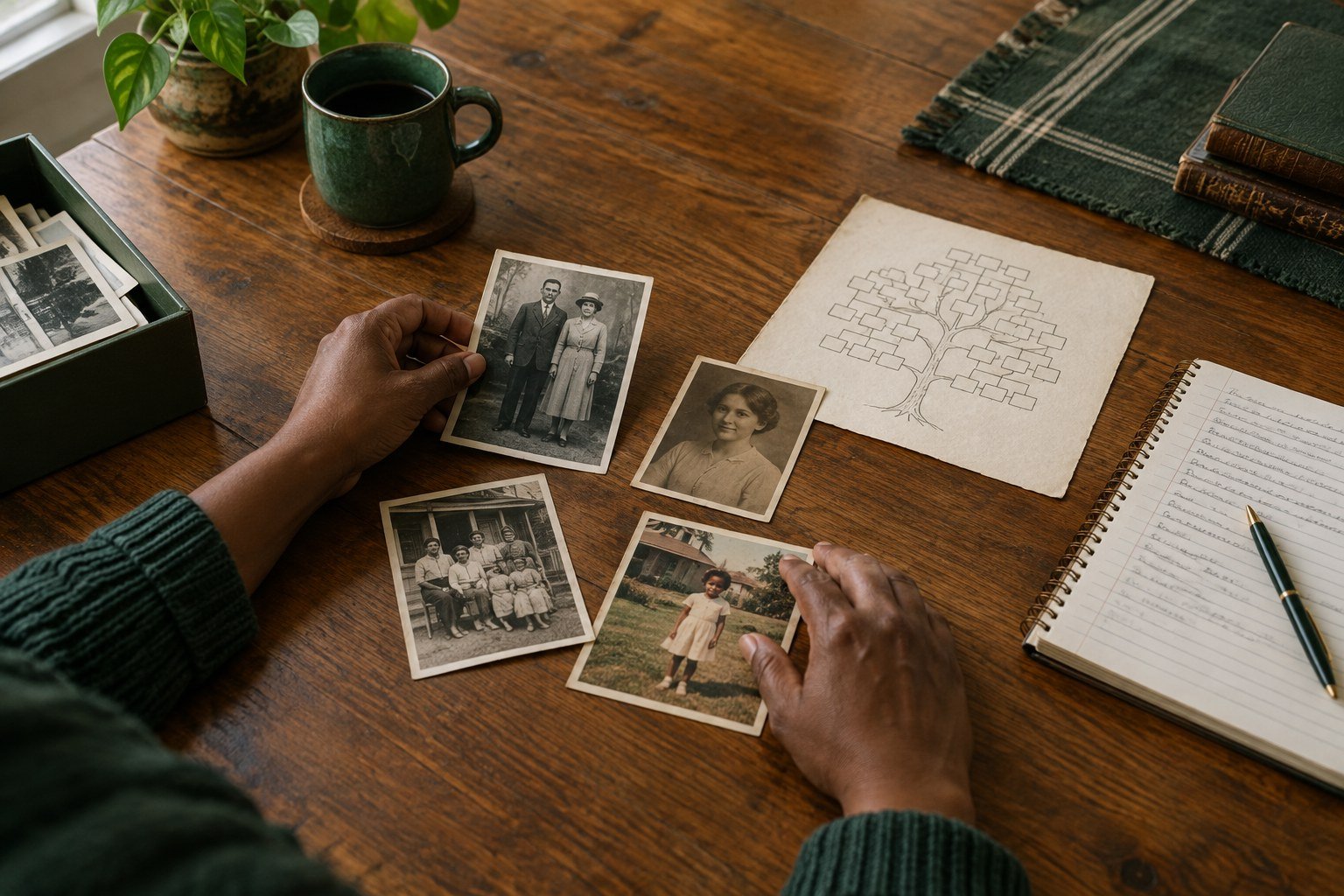
28 Sep The Family Tree Isn’t the Point: What Are We Really Searching for When We Search for Our Ancestors?
When my uncle asked if someone would continue our family reunion journal in 2002, I thought I was taking on a family tree. There were names to organize, relationships to check, and branches to fill in. I did not yet understand how many questions were waiting behind those names.
Over time, the research led me to relatives I had never known, including my biological paternal grandfather. It also led me into records that raised harder questions: Who had preserved this information? Who had been left out? And what would knowing more actually change for our family?
I still value the family tree. I use one in my own research. But the tree is a way to organize what we learn; it is not the whole reason we search.
What Are You Hoping to Find?
Before opening another database, I often ask a more basic question: What am I actually trying to learn? Sometimes the answer is straightforward. We want the name of a parent, a birthplace, a marriage date, or evidence that two people are related.
Sometimes the question underneath is different. We may want to understand why our family moved, why a story was never discussed, or where a familiar tradition began. We may be trying to locate ourselves within a history that has often been told without our families at the center.
Those questions do not all require the same kind of evidence. A census might help establish a household in a particular place. A letter might reveal how someone described that place. An interview with an elder might explain why the family left it. None of those sources should be asked to answer a question it cannot answer.
A Name Is a Beginning, Not a Person
A name in a record can feel like a breakthrough, particularly after months of searching. I know that feeling. But a name alone tells us very little about the person who carried it.
What work did they do? Who lived alongside them? What choices were available to them, and what choices were denied? What did they keep, change, or pass on? We will not always find answers, and we have to be careful not to turn silence in the archive into a story we cannot support.
This is why I look beyond direct ancestors when I can. Siblings, neighbors, witnesses, fellow church members, and people who migrated together may help us understand a life that one person’s records only partly document. In my guide to researching African American genealogy before 1870, I explain why those surrounding relationships become especially important when the record system changes.
The Questions Change as the Research Grows
At the start of my own journey, I wanted to know where in Africa my ancestors came from. That was a real and important question for me. It led me into traditional genealogy, archival research, and genetic genealogy, each of which offered a different kind of evidence.
Finding previously unknown relatives changed the questions I asked next. A relationship on paper became a relationship with living people. Learning about ancestry also made me think more carefully about place, identity, and what it means to reconnect with a history that extends beyond the borders of the United States.
I do not think every discovery has to produce a dramatic transformation. Sometimes the result is a more accurate family story. Sometimes it is a conversation we can finally have. Sometimes we are left with a new question and a better sense of where to look.
What a Family Tree Can—and Cannot—Hold
A family tree is excellent at showing relationships across generations. It can help us see patterns, spot conflicting dates, and decide which branch needs more research. I want those connections documented carefully, with sources attached wherever possible.
But a tree rarely shows how a person sounded, what they worried about, or what a family gathering felt like. It may not hold the story behind a photograph, the meaning of a nickname, or the reason a household took in a child who was not biologically theirs.
Those details belong in our family history too. An archive can include photographs, letters, recipes, oral histories, home videos, documents, and the notes we make while trying to understand them. We can preserve uncertainty as well as answers: “Auntie remembered it this way, but I have not yet found a record that confirms the date.” That is an honest and useful contribution.
Search With a Purpose, Then Leave Room to Be Surprised
A clear research question keeps us from collecting names without knowing why. If I am investigating one person, I might write down:
- What do I know from records I have actually seen?
- Which relationships are supported, and which are still assumptions?
- What places and time periods should I investigate next?
- Who else was connected to this person?
- What might living relatives remember that the records do not show?
Then I keep a record of where I searched and what I found, including searches that came up empty. That practice saves time later. It also helps me see when I am repeating a search instead of changing my approach.
Purpose matters, but so does curiosity. One of the most useful records may belong to a sibling. A photograph may prompt an elder to tell a story you did not know to ask for. A place name may become the clue that connects two branches. Good research gives us a direction without requiring every discovery to fit the plan we began with.
What Do We Do With What We Learn?
For me, this is where genealogy begins to connect with legacy. Once we learn something about our family, we have decisions to make. What should we verify? What deserves to be preserved? What can we share, and with whom? How do we describe painful histories with care and accuracy?
There is no single answer for every family. Some stories involve living people’s privacy. Some records are incomplete or contradictory. Some discoveries need time before anyone is ready to discuss them. Research is not only about obtaining information; it also asks us to think about our responsibility to the people represented in it.
My uncle’s journal gave me a place to begin. Years later, I still care about the names and the connections. I also care about the stories, the evidence, the unanswered questions, and what future generations will be able to understand because we took the time to document them.
The family tree matters. The people and the meaning behind it are why I keep researching.
About Aisha LaDon Abdul Rahman
Aisha LaDon Abdul Rahman, MLIS, PhD, is an archivist, genealogist, author, and heritage traveler. Her work brings together family research, archival preservation, ancestral reconnection, and questions of identity and legacy. She is the author of Tracing Our Roots, Reclaiming Our Legacy.