



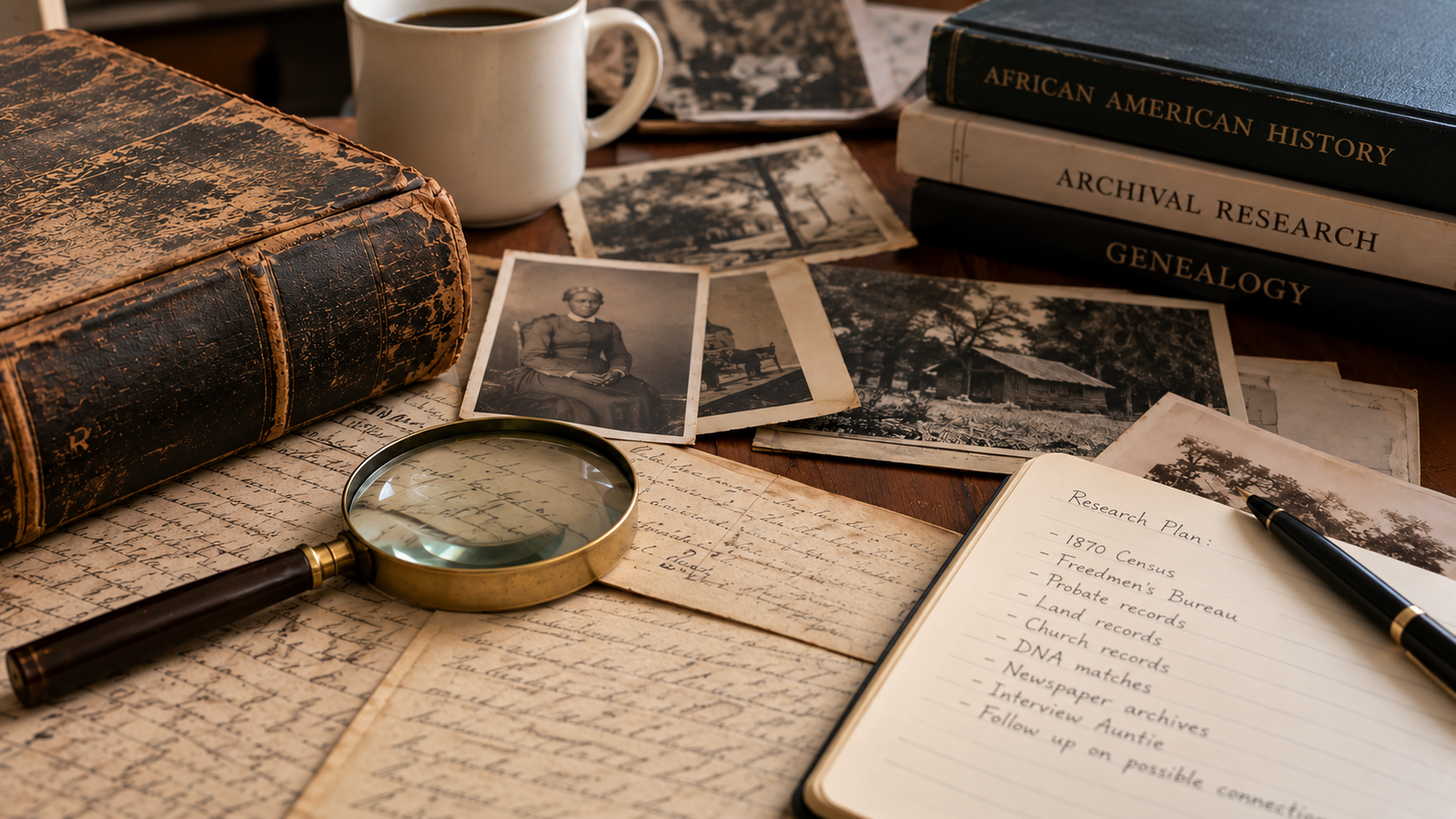
26 Sep Why African American Genealogy Gets Harder Before 1870—and Where to Look Next
If you have been researching your African American family for any length of time, you have probably heard about the 1870 brick wall.
You find your family in the 1900 census. Then 1880. Then, if you are fortunate, there they are in 1870.
And then everything changes.
The family you have been following by name seems to disappear.
For many African American researchers, this is the point where genealogy becomes frustrating. It can feel as though you have reached the end of the family line.
You haven’t.
But you may have reached the end of the kind of research you have been doing.
That distinction is important.
Before 1870, particularly when researching people who were enslaved, we have to approach the records differently. We may have to stop searching only for our ancestor’s name and begin searching for the people around them, the places where they lived, the people who may have enslaved them, and the records created because slavery treated human beings as property.
It is uncomfortable work.
It is also where some of the most important discoveries in African American genealogy can begin.
Why 1870 Matters in African American Genealogy
The 1870 United States Census was the first federal census taken after the Civil War and the abolition of slavery. It was also the first federal census to list formerly enslaved people by name as part of the general population.
That is why genealogists place so much importance on it. The National Archives’ 1870 Census guide provides additional information about the census and the records available to researchers.
If you find an African American family in 1870, you may see something that looks familiar:
- A name.
- A spouse.
- Children.
- Ages.
- Birthplaces.
- An occupation.
- A household.
Those details give us something to work with.
But go backward ten years to the 1860 census and the recordkeeping changes dramatically for an ancestor who was enslaved.
The 1850 and 1860 censuses included separate slave schedules. Those schedules generally identified slaveholders by name while recording enslaved people by characteristics such as age, sex, and color rather than by name. There were exceptions, but naming the enslaved person was not the norm. The National Archives discusses these records in its guide to federal records relating to slavery.
So imagine that you have found your ancestor:
Sarah Williams, age 32, Black, living in Mississippi in 1870.
You search for Sarah Williams in 1860.
Nothing.
That does not necessarily mean Sarah cannot be found.
It means “Sarah Williams” may no longer be the right search.
And this is where I think many researchers get stuck.
Your Ancestor Did Not Disappear. The Record System Changed.
One of the things my archival training has taught me is that records are not neutral.
Records are created for a reason.
Someone decided what information was worth recording, how it would be described, who would be named, who would not be named, and which records were worth keeping.
That matters tremendously when researching enslaved people.
In the 1850 and 1860 slave schedules, for example, the federal government was not creating a family history resource for us to use more than 160 years later. It was documenting slavery within the census system.
The resulting records reflect that purpose.
An enslaved woman who appears in 1870 with a first name, surname, husband, and children might appear ten years earlier only as a Black female of a certain age listed under the name of a slaveholder.
That is a completely different research problem.
The National Archives recommends investigating records associated with slaveholders when researching enslaved individuals. Relevant documents may be found at the county level and can include probate files, tax records, deeds, bills of sale, deeds of gift, mortgages, manumissions, and court records.
You can explore the National Archives’ broader African American slavery records research guide to see the variety of records that may be available.
So when I say that African American genealogy before 1870 requires us to read the archive differently, this is what I mean.
We aren’t only looking for names anymore. We’re looking for relationships between evidence.
Start With 1870—but Don’t Rush Past It
When someone tells me they have hit the 1870 brick wall, one of my first thoughts is:
How much do you actually know about the family in 1870?
Finding them isn’t enough.
Before jumping backward, slow down.
Look at the entire household.
Who is living there? Who lives next door? Who lives five houses away? Are there other people with the same surname nearby? Where were the adults born? What occupations are listed? Do they own real estate or personal property?
Then move forward.
Where are they in 1880? Where are their children twenty or thirty years later? Who did those children marry? What do later death certificates, marriage records, obituaries, military records, or other documents say about their parents?
Genealogy sometimes tempts us to move backward as quickly as possible.
I understand why. We want the answer.
But sometimes the information that helps us solve 1860 is sitting in 1880, 1900, a death certificate from 1922, a pension file, or the obituary of a child who lived much longer than the ancestor we’re researching.
I don’t assume that the earliest record is automatically the most useful record.
I am trying to build a body of evidence.
Your Next Question May Be: Who Enslaved My Ancestor?
This can be one of the most difficult transitions in African American genealogy.
You may need to identify the person or family who enslaved your ancestor.
That does not mean finding someone in the 1860 slave schedule whose enslaved population happens to include a person of approximately the right age and declaring the problem solved.
Age alone is not enough.
This is where we have to be careful.
Suppose Sarah Williams is 32 in 1870, which would place her birth around 1838.
You find a slaveholder named Williams in the same county in 1860 with a 22-year-old Black female listed on the slave schedule.
Interesting? Absolutely.
Proof? No.
Now we have a hypothesis to investigate.
Did Sarah live near this Williams family after emancipation? Were other members of her 1870 household potentially represented among that slaveholder’s enslaved population? Does the slaveholder’s probate file name enslaved people? Did he leave a will? Were enslaved people distributed among his heirs? Are there deeds, estate inventories, tax records, court cases, bills of sale, or plantation records?
Can Sarah be connected to other formerly enslaved people who were associated with that family?
Does a later record identify her parents?
That is how the research begins to move from possible to probable.
One record rarely tells the entire story.
Look at Probate and Estate Records
If I were researching an enslaved ancestor and had identified a possible slaveholder, probate and estate records would be high on my list.
Because slavery classified human beings as property, enslaved people could appear in records created when an estate was inventoried, divided, sold, inherited, or settled.
You may encounter:
- Wills
- Estate inventories
- Estate accounts
- Appraisals
- Distributions
- Guardianship records
- Deeds
- Bills of sale
These records can be painful to read.
You may find a child assigned a monetary value.
You may find a husband and wife distributed to different heirs.
You may find your ancestor listed beside livestock, furniture, land, and tools.
There is no reason to sanitize what these documents represent.
But genealogically, they can contain information that helps us reconstruct families whose relationships were not adequately preserved elsewhere.
Sometimes a probate record provides a name.
Sometimes it provides several names together.
Sometimes the real clue isn’t the person you’re looking for at all. It is another person associated with them.
That is why I recommend researching families and communities, not only individuals.
Don’t Overlook Freedmen’s Bureau Records
The Bureau of Refugees, Freedmen, and Abandoned Lands—usually called the Freedmen’s Bureau—operated during Reconstruction and generated an extraordinary variety of records.
The Bureau’s work included labor contracts, schools, hospitals, rations, legal disputes, marriages, apprenticeships, transportation, and matters involving separated families.
The National Archives Freedmen’s Bureau research guide is a useful place to understand the scope of the collection.
Think about what that means for genealogy.
A labor contract may place an ancestor on a particular plantation after emancipation.
A marriage record may document a relationship that began during slavery.
A complaint may identify family members.
A transportation record may provide evidence of movement from one location to another.
A school record may identify children.
These aren’t simply “Freedmen’s Bureau records.”
They are records created during a period when formerly enslaved people were building lives, formalizing relationships, searching for family, working, moving, learning, and negotiating freedom.
And they can help us bridge the period between slavery and freedom.
Check Freedman’s Bank Records
Another collection worth investigating is the Freedman’s Savings and Trust Company, commonly called the Freedman’s Bank.
The bank was established in 1865 and ultimately failed in 1874, with devastating consequences for many depositors. But the records it created can be extremely valuable to genealogists.
Some records contain detailed information about depositors and their families. The National Archives Freedman’s Bank research guide describes the surviving material and its value for African American family research.
If your ancestor had an account, you may find information capable of connecting generations that are difficult to connect through census records alone.
This is also a good example of why I tell researchers not to think only in terms of “genealogy records.”
A bank record wasn’t created for genealogy.
Neither was a probate file.
Neither was a labor contract.
Neither was a military pension.
The question isn’t:
“Is this a genealogy record?”
The better question is:
“Could this record contain evidence about my family?”
That’s a much bigger search.
Military Records Can Open Another Door
If an African American man in your family was of military age during the Civil War, investigate whether he served in the United States Colored Troops or the Union Navy.
The National Archives includes military records among the federal sources that can help researchers investigate formerly enslaved people.
And don’t stop with the service record.
Look for pension records when they exist.
Pension applications could require veterans, widows, and other applicants to document marriages, children, relationships, service, injuries, and other facts about their lives.
That process could generate testimony and supporting evidence that may not survive anywhere else.
Again, don’t decide in advance what a record will tell you.
Look at it.
Research the Community, Not Just Your Direct Ancestor
This is one of the biggest shifts I would encourage if you are stuck.
Your ancestor existed within a network.
They had siblings, parents, children, neighbors, friends, church communities, people they worked beside, people they traveled with, people who witnessed their marriages, people who served with them, and people who migrated with them.
If you cannot get through the brick wall using your direct ancestor, go sideways.
Research the brother.
Research the sister.
Research the neighbor who keeps appearing.
Research the family living two doors away in 1870.
Research the witnesses on marriage records.
Research people with the same surname in the same community.
One of those people may have left behind the record your direct ancestor did not.
The answer is not always sitting under the name you started with.
Oral History Still Matters
I am an archivist, so obviously I believe in records.
But I don’t believe the archive contains everything worth knowing.
Family stories matter.
Interview your elders. Ask about nicknames. Ask where people lived. Ask who raised whom. Ask which families were considered cousins even when no one remembers exactly how. Ask where people went to church. Ask about migrations. Ask about land. Ask about stories people were told when they were children.
You should still verify what can be verified.
Memory changes. Family stories can combine people or events, and information can shift as it moves from one generation to another.
But don’t dismiss oral history simply because it isn’t a government document.
Sometimes a small detail in a family story gives you the language, location, relationship, or surname you need to find documentary evidence.
And sometimes the oral history itself is part of what deserves to be preserved.
Read Historical Narratives Too
Not every useful source has to name your ancestor.
Sometimes we need context.
The Library of Congress’s Born in Slavery: Slave Narratives from the Federal Writers’ Project collection contains more than 2,300 first-person accounts of slavery collected during the 1930s, along with hundreds of photographs.
These accounts have limitations.
They were collected decades after emancipation. Memory is imperfect. The circumstances of the interviews—including who conducted them and how speech was recorded—matter when interpreting the material.
The Library of Congress provides a useful discussion of the limitations of the slave narrative collection.
But historical context can help us understand the communities our ancestors lived within.
If your ancestor lived in a particular county in Mississippi, Georgia, Virginia, or another former slaveholding state, don’t research only your ancestor.
Research the county. Research slavery in that county. Research the plantations. Research the churches. Research Reconstruction. Research migration patterns. Research the slaveholding families. Research what happened there during the Civil War.
The more you understand the world surrounding your ancestor, the better you become at recognizing evidence when you see it.
And What About DNA?
DNA can absolutely be part of this research.
But I don’t treat DNA as a replacement for the paper trail.
This is something I have learned through my own genealogy journey.
I’ve tested with multiple companies and have used DNA to explore family relationships and African ancestry. I have also seen how confusing ethnicity estimates and regional assignments can become when people expect them to answer questions they weren’t designed to answer.
My first question is always:
What are you trying to learn?
Are you trying to identify an unknown parent? Confirm a family relationship? Find descendants of another branch? Investigate a particular ancestral line? Explore African ancestry?
Those are different research questions.
The DNA tool you use—and how you interpret the result—should follow the question.
For pre-1870 research, DNA matches can sometimes provide evidence of connections among descendants of enslaved families or descendants of slaveholding families. But DNA evidence still has to be evaluated alongside documentary research.
A match is a clue.
A percentage is information.
Neither one automatically tells the entire story.
A Practical Research Plan for Getting Beyond 1870
If you’re sitting in front of your computer right now wondering what to do next, this is where I would start.
-
Document the family forward and backward from 1870.
Don’t rush past Reconstruction. Learn everything you reasonably can about the family before attempting to make the leap into slavery-era records. -
Identify the location precisely.
County-level research becomes increasingly important as you move into records created during slavery. -
Study the people around your ancestor.
Surnames, neighbors, relatives, associates, witnesses, and migration patterns can all become clues. -
Investigate possible slaveholders carefully.
Treat a matching surname, location, or age as a lead—not proof. -
Move beyond the census.
Look for probate, estate, deed, tax, court, church, military, Freedmen’s Bureau, Freedman’s Bank, land, and other local records. -
Research associated families.
Your ancestor’s sibling, child, neighbor, or associate may have left the evidence your direct ancestor did not. -
Use DNA strategically.
Start with a research question rather than asking your DNA results to tell you who you are.
And throughout all of this:
Keep track of what you know, what you think you know, and what you still need to prove.
Those are three different things.
The Archive May Get Quieter. That Doesn’t Mean the Story Ends.
I understand why people become discouraged at 1870.
You spend months or years following names backward through records, and suddenly the method that has been working stops working.
But I don’t think of 1870 as the place where African American genealogy ends.
I think of it as the place where the research changes.
Before 1870, we may have to work harder.
We may have to search records created by slaveholders.
We may have to reconstruct families one clue at a time.
We may have to learn the history of a county we’ve never visited.
We may have to read wills that are difficult to read, follow people who aren’t our ancestors, search archives that aren’t completely digitized, and sit with uncertainty longer than we’d like.
But our ancestors existed before someone wrote their names in the 1870 census.
They had mothers and fathers.
They had relationships.
They lived in communities.
They worked, moved, married, resisted, worshiped, loved, survived, remembered, and passed things forward.
The difficulty is not that they had no history.
The difficulty is that the records did not preserve their lives in the way we wish they had.
Our job as researchers is to learn how to look for what remains.
And sometimes, one record at a time, the family begins to come back into view.
About Aisha LaDon Abdul Rahman
Aisha LaDon Abdul Rahman, MLIS, PhD, is an archivist, genealogist, author, heritage traveler, and transpersonal psychologist whose work explores African American genealogy, ancestral reconnection, identity, family preservation, and legacy. She is the author of Tracing Our Roots, Reclaiming Our Legacy.