"Yu noh sabi usai yu de go if yu noh sabi usai yu komot."
"You cannot know where you are going if you do not know where you come from." — Krio proverb
That belief is not a slogan. It is the reason I became an archivist. It is the reason I spent two decades tracing my family's roots back through Virginia, Maryland, and New Orleans. It is the reason I submitted my DNA, boarded a plane to West Africa, received citizenship in Sierra Leone, and built a compound in a Temne village outside Waterloo. Everything I do — the research, the courses, the museum exhibits, the retreats — is built on one conviction: that African American families deserve to know who they were before the ships, and that recovering that knowledge is one of the most powerful things a person can do.
I am an archivist and genealogist specializing in the preservation of African American heritage and culture. I work with institutions — museums, libraries, historical societies, private estates — and I work with families. The tools are different. The goal is the same: to ensure that what was nearly lost is found, documented, and passed on.
My professional journey in archival work began long before I held the credentials. I have been doing genealogy research since 2002, when my great-uncle handed me the family tree at a family reunion and asked me not to let it die. That request became a calling.
Today, through Legacy Planning & Preservation LTD, I provide archival, collections management, and records management services to heritage organizations, cultural institutions, and private families. I have served as the first archivist and consultant for the Sojourner Truth African Heritage Museum in Sacramento, where I assessed, inventoried, and digitized a collection of murals and West African artifacts — creating 3D LiDAR scans of select objects and building a digital exhibit accessible by QR code inside the museum. In partnership with the California State Railroad Museum, I developed an augmented reality experience embedded within a large-scale mural on railroad history: visitors scan hidden QR codes throughout the mural to trigger AR videos, photographs, and historical information tied to each specific location.
In New York, I worked with the Lewis Latimer House Museum in Flushing, in partnership with the New York Public Library's Jamaica Queens branch, to digitize their collections and build a cataloging and digital access system for researchers and community members.
Not all of my work lives in institutions. Some of the most meaningful projects I have done are private — including a multi-generational collection for descendants of Holocaust survivors, spanning three to four generations of family history: documents, military letters)tary letters, personal correspondence, birthday cards, currency from countries the family had visited, cassette audio, film, and home videos. Every item was digitized, cataloged, and described with metadata so the family's own programmer could build a private collection management system around it. There was no public exhibit. The family received their history on an SD card. That was exactly right.
The personal and the professional have never been separate for me. For years, I documented my own family research journey on YouTube — visiting the places my family came from, digging through historical records, trying to push past the brick wall that slavery builds in every African American family tree. I used every tool available: 23andMe, MyHeritage, Ancestry.com, and African Ancestry. I recruited the men in my family to participate in Y-chromosome testing. I did mtDNA testing — the test that traces the direct maternal line, mother to mother, back five hundred to five thousand years.
That results showed a 100% match to the Jola and Fula peoples of Guinea-Bissau, the Mende and Temne peoples of Sierra Leone, and the Kru people of Liberia.
That match qualified me to apply for Sierra Leone citizenship. What followed became one of the most documented journeys of my life.
- 2022 I traveled to Sierra Leone, participated in a Mende naming ceremony and a Temne naming ceremony, met with President Bio, and received my citizenship and passport. I documented the entire process day by day as a mini-documentary, published on YouTube.
- 2024 I returned to Sierra Leone and purchased land in Newton Village — a living Temne community outside Waterloo, part of the Ma Brown family-owned community. Construction began on a compound that would eventually become the home base for Ye-Ruqor Heritage Retreats.
- 2026 Construction is complete. The compound is off-grid and solar-powered. I returned to receive the keys and finalize the remaining work. The next chapter — furnishing the space, hosting retreats, welcoming guests into a liviinto a living Temne village — is almost here.
I filmed the citizenship trip and the years of building Ye-Ruqor day by day — the naming ceremonies, the land purchase in Newton Village, and the compound taking shape. Here's the full series.
The Citizenship Journey
Sierra Leone Citizenship: Requirements for African Americans
Building Ye-Ruqor
I Signed My Jobomax Home Contract in Sierra Leone 🇸🇱 | Real Estate for Diaspora Buyers
In 2024, I joined Sierra Community College as a community education instructor, teaching online courses on family archive organization, digitization, and genealogical research — including genetic genealogy. What began as a single course has grown into a full curriculum of eight classes. Those same modules are available here on this site, as part of a prerecorded Master Course and individual standalone modules, so that anyone — regardless of where they live — can learn to do this work.
My book, Tracing Our Roots, Reclaiming Our Legacy, is the written foundation of everything I teach. It is the map I wish I had when I started.
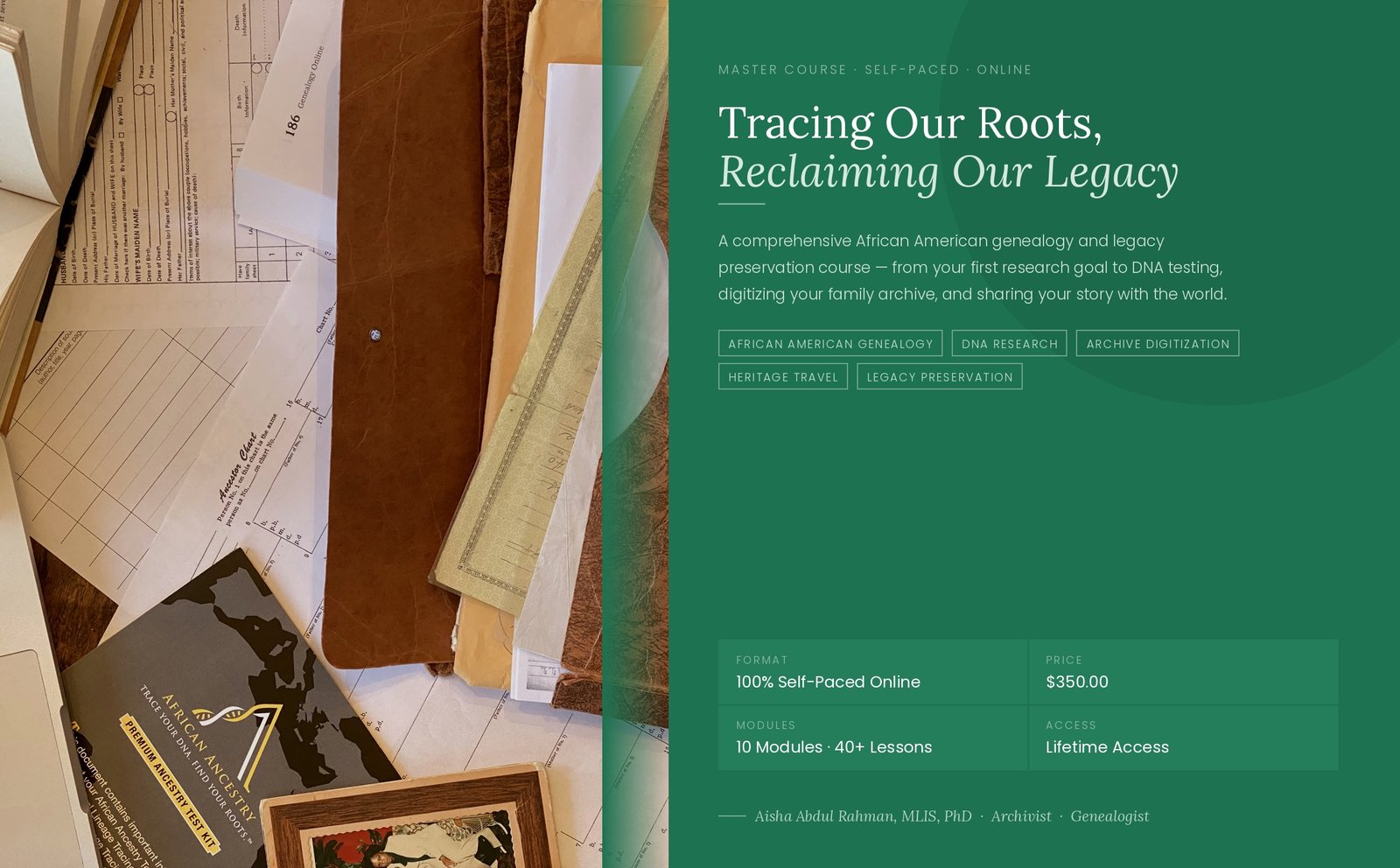 Master Course
Tracing Our Roots, Reclaiming Our Legacy
10 modules · 40+ lessons
The complete African American genealogy curriculum — from your first search to DNA testing, digitizing your family archive, and sharing your story with the world.
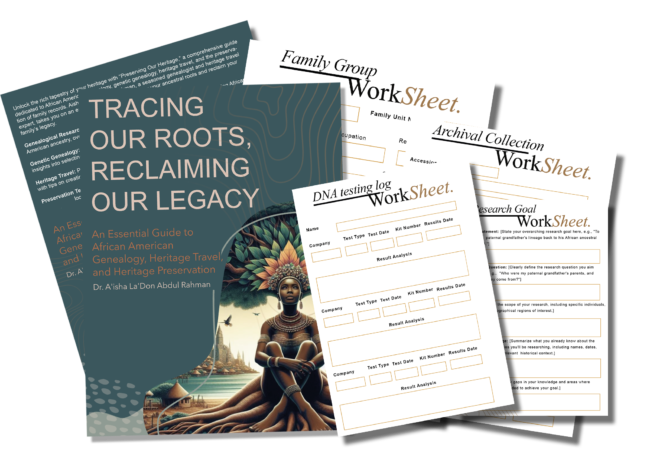 The Book
Tracing Our Roots, Reclaiming Our Legacy
An Essential Guide to African American Genealogy · Aisha L. Abdul Rahman
A step-by-step guide to researching African American family history — from your first search to DNA testing, heritage travel, and preserving what you find. Includes worksheets, templates, and practical guidance rooted in real genealogical practice.
The credentials came in the order the work required them — first the practice, then the formal recognition of what the practice had already become.
Ready to reclaim your story?
Whether you are tracing your family's roots, preserving a private collection, or looking for institutional archival expertise — this work begins with a conversation.
Get in Touch